In 2026, securing a residence permit has become a strategic move for investors, entrepreneurs, remote professionals, and families. Beyond relocation, it provides access to better lifestyle options, tax benefits, business opportunities, and even a path to citizenship. Many countries now offer programs that are flexible, fast, and tailored to attract foreign residents, making it easier than ever to obtain legal residency abroad.
Here are the 5 easiest countries to get a residence permit in 2026, with expanded details and key advantages for each.
Greece – Golden Visa Residency by Real Estate (2026)

Greece remains one of the easiest and most cost-effective ways to obtain a residence permit in Europe through property investment. Under the Greek Golden Visa Program, non-EU investors can secure a 5-year renewable residence permit by purchasing real estate. The minimum qualifying investment depends on property type and location: €800,000 for top-tier metropolitan and island hotspots like Athens, Thessaloniki, Mykonos, and Santorini, €400,000 in key urban zones, or €250,000 in designated restoration and commercial-to-residential conversion projects. Processing typically takes around 4–6 months. This program allows applicants to include spouses, children (often up to age 21), and even parents in the same application. While the permit does not automatically grant EU citizenship, investors become eligible to apply for Greek citizenship after 7 years of physical residency. Additionally, residents enjoy visa-free travel across the entire Schengen Area, potential rental income from their investment property, and access to Greek healthcare and education.
Key Advantages:
- Real estate investment threshold as low as €250,000 in qualifying categories
- 5-year renewable residency permit
- No minimum physical stay requirement to maintain residency
- Family inclusion (spouse, children, often parents)
- Schengen Area visa-free travel
- Rental income potential from investment property
- Pathway toward citizenship after 7 years of residency
Cyprus – Permanent Residency Through Property Investment
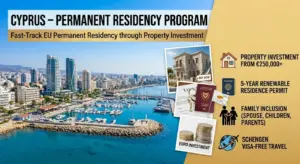
Cyprus offers one of the fastest permanent residency programs in Europe through real estate investment. Applicants can obtain EU permanent residency by investing a minimum of €300,000 in qualifying real estate, commercial properties, securities, or company shares. Permanent residency is typically granted within 6–8 months, and while it doesn’t require extensive time spent in the country, residents must visit at least once every two years to maintain their status. Cyprus also provides a tax-favorable environment with low income and corporate tax rates, no inheritance tax, and exemptions on certain global income categories making it appealing for international investors and business owners. Permanent residents and their families benefit from access to quality healthcare, international schools, and a strategic location at the crossroads of Europe, the Middle East, and Africa. After 8 years of continuous residency, investors may be eligible to apply for Cypriot citizenship.
Key Advantages:
- Permanent residency for life with property investment (from €300,000)
- Quick processing (about 6–8 months)
- Family included (spouse, children, sometimes parents)
- No requirement for full-time physical residence
- Attractive tax framework including low corporate and no inheritance tax
- Access to European healthcare, education, and lifestyle
- Pathway to citizenship after ~8 years of residency
Latvia – Affordable EU Residency Entry (Temporary Permanent)
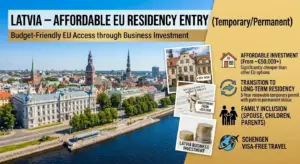
Latvia is one of Europe’s most affordable entry points for residency by investment, offering access to the Schengen Area at a relatively low cost. Qualifying investors can obtain a temporary residence permit (usually 5 years) by making a qualifying investment, often around €50,000 in a Latvian company or business entity. This option can lead to a long-term residency track if regulatory conditions are met, including maintaining the investment and fulfilling annual requirements. Latvia’s residency permits allow travel within the Schengen Zone, providing significant mobility across Europe. Although the path to permanent residency and eventually citizenship is longer compared to countries like Greece or Cyprus, Latvia’s low entry cost makes it appealing for budget-minded global citizens aiming for EU access.
Key Advantages:
- Low investment threshold (~€50,000), significantly cheaper than many EU alternatives
- Schengen travel rights upon approval
- Residence permit valid for multiple years (renewable)
- Possibility to transition to permanent residency over time
- Access to Europe’s legal and business environment
- Budget-friendly entry for families and investors
Malta – Permanent Residency Programme Through Property & Contributions
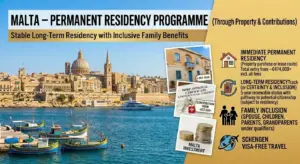
Malta’s Permanent Residence Programme (MPRP) is highly regarded for its stability, long-term residency, and inclusive family benefits. Unlike some European programs that offer temporary residency first, Malta’s MPRP provides immediate permanent residency upon approval, typically within 6–10 months. Investment through property can be structured in two main ways: purchasing a property typically valued at €375,000 (or more), or leasing with a long-term minimum rental commitment. Additional required costs include a government contribution (~€37,000), administrative fees, and a charitable donation, meaning total investment including all fees often ranges from ~€474,000 and up depending on the structure chosen. Malta’s residency is renewed every five years, and applicants can include spouses, dependent children, parents, and even grandparents under certain conditions. Permanent residents enjoy Schengen travel benefits, favorable tax policies, excellent healthcare, and access to English-medium education.
Key Advantages:
- Immediate permanent residency (no temporary permit first)
- Multiple property investment routes (purchase or lease)
- Family inclusion (spouse, children, parents, grandparents under qualifiers)
- Schengen travel access
- Strong healthcare and education systems
- Favorable tax environment
- Long-term residency certainty and quality of life
UAE – Long-Term Residency Through Propert Investment
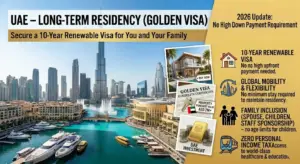
The United Arab Emirates offers an increasingly popular Golden Visa route tied to property investment, allowing international investors to secure long-term residency with a minimum real estate investment of AED 2,000,000 (around USD 544,000+). Qualifying investors can receive 5- or 10-year renewable residency permits without the need for employer sponsorship. There is no minimum stay requirement to maintain residency, granting flexibility for international business people, remote professionals, and property investors. UAE residency holders also enjoy a tax-free income environment, access to advanced infrastructure, world-class healthcare, and education systems. Investors can include spouses and children on the same visa, making it attractive for families. Property in cities like Dubai and Abu Dhabi offers rental income potential and capital appreciation, enhancing the financial appeal of residency investment. While UAE’s Golden Visa does not directly lead to citizenship, it provides exceptional stability and global opportunity.
Key Advantages:
- Long-term residency (5–10 years) renewable through property investment
- No employer sponsorship needed
- Flexibility to maintain residency without full-time physical presence
- Tax-free personal income environment
- Family inclusion on the same visa
- Rental and capital growth potential from property investment
- Access to world-class infrastructure, healthcare, and education